
CubeSmart — National Brand Identity and Graphic Standards

CubeSmart didn’t begin as CubeSmart. It began as U•Store•It — an established national self-storage chain with hundreds of facilities across the country. The decision to rebrand, and the new name itself, came from the client. What they needed was someone to make that name into a mark — and the mark into a complete, living brand system that could govern every touchpoint of a national retail operation.

That’s where I came in. Commissioned as an independent project during my tenure at Cisco Systems, this was one of those engagements that demanded the full range of what I do best: custom type design, proportional precision, and the discipline to build a visual identity system rigorous enough to survive intact across thousands of facilities, dozens of advertising formats, and years of operational use.

I designed the CubeSmart wordmark from scratch — custom-drawn letterforms with proprietary glyph modifications that give the mark its distinctive character and ensure it reads as a composed, unified whole. The cubic icon that accompanies the wordmark is deceptively simple: a three-dimensional form that communicates storage, structure, and spatial intelligence in a single gesture, drawn with the same precision and optical refinement as the letterforms it sits beside. The mark was built in both outlined and solid variants, with stroke weights specified to fractions of the cap height to ensure consistent reproduction across every application at every scale.

The engagement extended well beyond the mark into a comprehensive graphic standards manual — the document that transforms a logo into a living brand system. The manual specified everything: wordmark construction and minimum margin rules derived from the proportional relationships within the mark itself; a typographic system anchored by Gotham Condensed Bold for headline use, with precise leading, letterspacing, and kerning values specified for Adobe Illustrator production; disclaimer and legal type specifications; phone number formatting rules; color palette across print and digital applications; and layout proportion grids governing how brand elements relate to each other across every format.

That system was then applied across the full spectrum of CubeSmart’s physical and digital presence — outdoor and large-format advertising, banner and point-of-sale materials in multiple colorway variations, website UI design, and the launch campaign that announced the transformation to the world: “U-Store-It… Reinvented!” — a line that acknowledged the legacy directly while declaring the ambition of what was coming.

The standards also covered architectural signage, building facade treatments, interactive advertising templates, and employee uniforms — the full environmental and operational spectrum of a national retail brand. Every touchpoint, every format, every application governed by the same proportional logic and typographic discipline that begins in the wordmark itself.

CubeSmart remains in active national use today, visible on facilities across the country. That kind of longevity is the most honest measure of whether a brand identity was built to last.

Creative Direction; Logo Design; Typography Design; Graphic Standards; Indoor/Outdoor Signage; Operations Graphics
Yafo Networks — Identity, Website, and Print Design

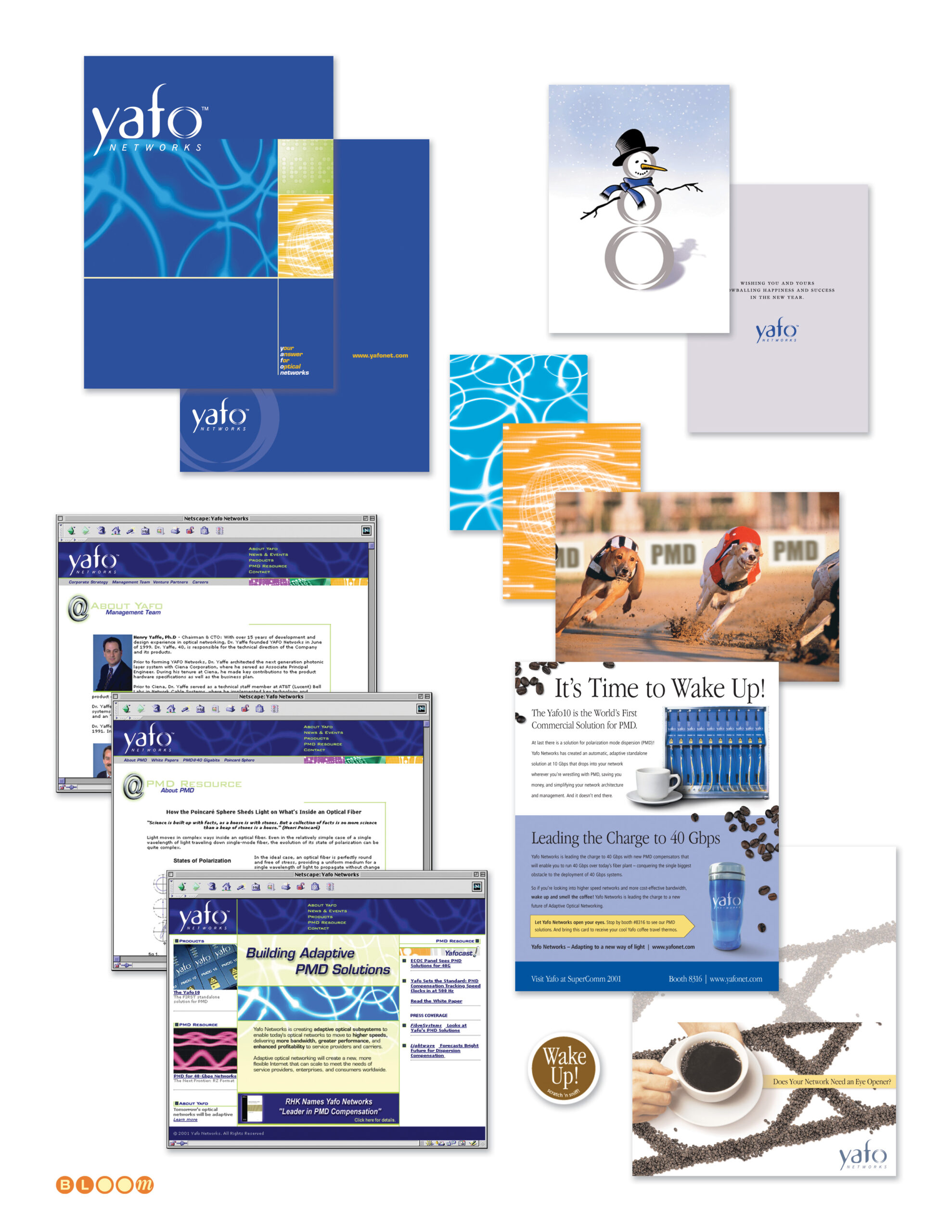
Yafo Networks creative folio showing brand identity, cobalt and aqua wordmark with orbital ring logo, Netscape frames-based website design, PMD print advertising, Wake Up trade show campaign, direct mail, and seasonal greeting card designed by The Bloom Agency

The name was, by the founders’ own admission, a joke — YAFO: Yet Another Fiber Optic networking solutions company. It was the kind of self-aware humor that signals a technically confident team comfortable enough with the crowded optical networking landscape of the early 2000s to acknowledge it directly, because they knew they had something nobody else had cracked.

What they had was a solution to polarization mode dispersion — PMD — the signal degradation phenomenon that was blocking telecommunications carriers from upgrading their existing fiber infrastructure to 40 Gbps speeds. The alternative to solving PMD was replacing the fiber. YAFO’s hardware and software compensation technology meant carriers could maximize the utility of their current assets instead. Founded in June 1999 by Henry Yaffe in Hanover, Maryland, the company raised $61 million in venture capital across three rounds before its acquisition by Ciena Corporation — a validation of both the technology and the market timing.

The Bloom Agency was engaged for the full creative scope of YAFO’s marketing communications: identity design, website design, print advertising, trade show campaign, direct mail, and corporate collateral — all of it built in the compressed, capital-intensive atmosphere of the early 2000s optical networking market.

The Yafo logo is my design — a lowercase wordmark in a deep cobalt and aqua palette, with an orbital ring element arcing over the o. The ring is a deliberate double reference: to the optical lenses at the heart of the technology, and to the high-speed networking rings the product was designed to liberate. Light moving through glass at extraordinary speed, made visible in a single typographic gesture.

The website was designed in frames-based architecture for Netscape — the production reality of early 2000s web development — with a full site structure covering corporate strategy, management team, product information, a PMD Resource educational center, press coverage, and investor relations. Getting technical depth and marketing clarity to coexist in that environment required both design discipline and genuine understanding of what the product actually did and why it mattered.

The trade show campaign for SuperComm 2001 — Booth 8316 — was anchored by the “It’s Time to Wake Up!” concept, built around the insight that the industry was sleeping on the PMD problem at 40 Gbps while YAFO had already solved it. The campaign extended across print advertising, trade show materials, and a direct mail invitation that arrived sealed with a coffee-flavored scratch and sniff sticker. The concept and the execution were in complete alignment: every recipient who scratched that seal understood the campaign before they read a word. The greyhound billboard composite — an early Photoshop background replacement technique used as a campaign visualization — rounded out the competitive speed messaging.

The seasonal greeting card completed the relationship collateral — a snowman assembled from the Yafo orbital ring elements, wishing clients and partners happiness and success in the New Year with the same quiet wit that named the company in the first place.

Brand Identity, Logo Design, Orbital Ring Illustration, Website Design, Frames Architecture, Print Advertising, Trade Show Campaign, Direct Mail, Scratch and Sniff Production, Corporate Collateral, Seasonal Greeting Card, Production Management

Screen47.com — “We’re Rolling”

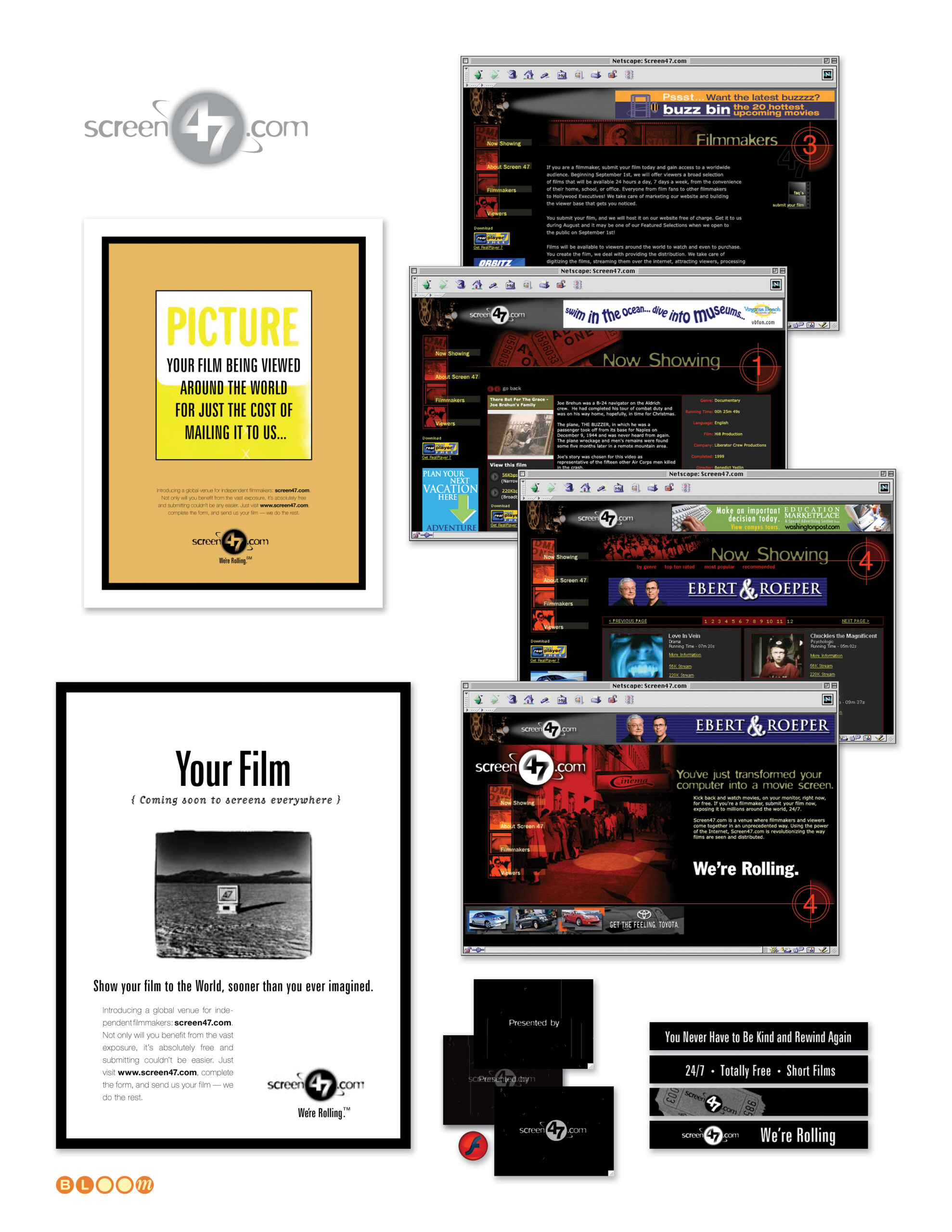
screen47.com campaign folio showing logo, Netscape 2.0 website UI designs, print advertising, direct mail, and Flash interactive elements created by The Bloom Agency — featuring the We're Rolling campaign line and Ebert and Roeper partnership

Before YouTube. Before broadband made streaming viable for the average household. Before anyone had coined the term user-generated content. There was screen47.com — a concept so ahead of its moment that the infrastructure to support it simply did not yet exist at the scale required.

The Bloom Agency was engaged to create the complete brand identity, website design, and marketing campaign for screen47.com — a global venue for independent filmmakers to submit, stream, and distribute their work to audiences worldwide, free of charge. The platform’s value proposition was elegant and genuinely radical for its time: you submit your film, we handle the distribution, the digitizing, the streaming, the audience building. Your film. Coming soon to screens everywhere.

The name encoded a quiet piece of conceptual depth — 47 is the atomic number of silver, a reference to the silver screen, tying a digital-native platform back to the physical poetry of cinema with a single numeral. The logo’s orbital ring system around that numeral suggested both planetary motion and content in perpetual circulation — a mark designed for a medium that hadn’t fully arrived yet.

The agency created the “We’re Rolling” campaign line — a phrase that does three things simultaneously: signals that the cameras are running, that the platform is live, and that the business has momentum. It ran across print advertising, direct mail, and the website UI itself, anchoring a visual system built in Netscape 2.0 that anticipated the streaming era with remarkable clarity.

The campaign attracted genuine institutional credibility. Film critics Roger Ebert and Richard Roeper were not merely conceptual supporters — they provided filmed endorsements specifically to support the client’s venture capital fundraising effort. That level of editorial endorsement for a platform concept that hadn’t yet reached scale speaks to how compelling the idea was to people who understood the future of film distribution.

A working demo of the site was built and demonstrated. The obstacle was not the concept, not the design, not the endorsements, and not the market appetite. It was bandwidth economics — access costs and service capacity made viable streaming prohibitively expensive at the scale required for the platform to gain real traction. The client ran out of runway before the infrastructure caught up. A competitor with a longer war chest and better timing eventually built the same idea and called it YouTube.

The work remains one of the most forward-looking engagements in The Bloom Agency’s history — and a reminder that being right about the future is not always enough.

Brand Identity, Logo Design, Campaign Concept, Tagline Development, Website Design, Print Advertising, Direct Mail, Interactive Design, Flash Production