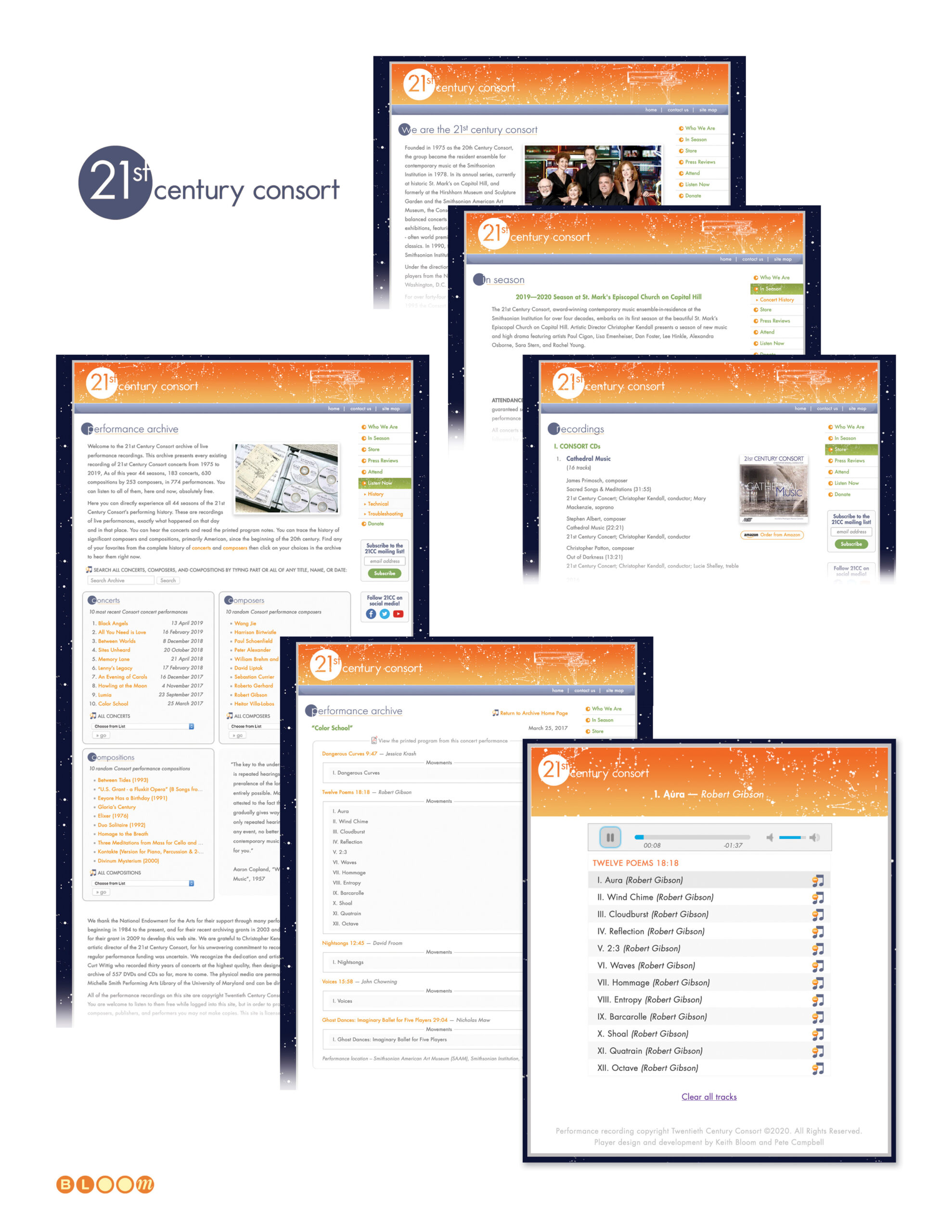
The 21st Century Consort was founded in 1975 as the 20th Century Consort — the resident ensemble for contemporary music at the Smithsonian Institution. For over four decades, the group has performed world premieres and balanced concert programming at St. Mark’s Episcopal Church on Capitol Hill, the Hirshhorn Museum and Sculpture Garden, and the Smithsonian American Art Museum, under the artistic direction of Christopher Kendall. By any measure it is one of Washington’s most significant serious music institutions — and one whose digital presence needed to match the depth and rigor of its archive.
This was a full technical and creative engagement, carried out as an independent project alongside my tenure at Cisco Systems. I designed and built the site in ExpressionEngine — beginning with version 2.5 and maintaining it through versions 5 and 6 over the course of the relationship — developing the content architecture, layout system, and CMS structure that would accommodate both the organization’s ongoing season programming and its deepening historical archive.
The performance archive is the heart of the site and its most technically ambitious component: a fully searchable database spanning 44 seasons, 183 concerts, 630 compositions by 253 composers, documented across 774 individual performances — all retrievable by title, name, or date, with individual program notes, composer profiles, and concert records fully cross-referenced. Building and maintaining that architecture — and populating it as decades of analog recordings were digitized from archive tapes and other legacy media and added in batches — was as much a library science project as a web development engagement. The physical recordings themselves — 557 DVDs and CDs archived by recording engineer Curt Wittig — are permanently preserved at the Michelle Smith Performing Arts Library at the University of Maryland, with the digital archive serving as the public access layer for that collection. The National Endowment for the Arts supported the archive’s development through performance grants beginning in 1984, with a specific grant in 2009 to fund the website itself.
The streaming audio player was co-developed with Pete Campbell, who contributed the initial jQuery and JavaScript assets before I assumed full ownership of scripting updates and revisions. The player went through multiple iterations tracking the evolution of streaming infrastructure — from Darwin Streaming Server through at least two successive IceCast Streaming Media service versions — each requiring the media library and player architecture to be adapted accordingly.
The client behind this project was, in his own way, a perfect collaborator — a deeply technical database enthusiast who shared the same appetite for chasing elegant solutions that’s always driven my best work. Many of the annual media library import sessions happened in cafes and shared workspaces around Washington, two people who genuinely enjoyed the problem as much as the solution. That kind of working relationship is rare, and it produced something that held together through nearly two decades of technological change.
In 2021, the client transitioned leadership of the digital relationship to a new board member who standardized the main site around a WordPress platform. The streaming library architecture wasn’t compatible with the new infrastructure, and the long collaboration concluded. What remains is a record of what was built — and something more than a record. The performance archive, still running on the IceCast streaming infrastructure as originally designed and built, continues to serve the complete catalog of 44 seasons, 630 compositions, and 774 performances to listeners worldwide, long after the main site moved to a new platform. The architecture quietly outlasted the transition.
Website Design, CMS Development, ExpressionEngine, Performance Archive Database Architecture, Streaming Audio Player Design and Development, IceCast Streaming Media Integration, Media Library Architecture, Content Management, Annual Media Library Updates
www.21stcenturyconsort.org