
Logos and Identities

Collection of logo and identity designs by Keith Bloom including CubeSmart, Chronology Productions, Vélocity Bicycle Co-op, Georgetown Partnership, Hist1H1e Foundation, Cavalier Telephone, screen47, and The Third Way Foundation

Identity design is where my instincts are most exposed. There is nowhere to hide in a logo — every decision about form, weight, letter spacing, and concept is either right or it isn’t. The marks collected here span three decades, eight organizations, and a range of briefs as different from one another as their sectors. What connects them is a consistent design philosophy: type-driven, conceptually grounded, and built to work as hard as the organizations they represent.

CubeSmart is the flagship engagement in this collection and one of the most visible pieces of work in my portfolio. Commissioned for a complete rebrand of the national self-storage company, the assignment began with the wordmark — custom-drawn letterforms with proprietary glyph modifications that give the mark its distinctive character and ensure it reads as a composed, unified whole rather than a typeface applied. The cubic icon above the wordmark is deceptively simple — a three-dimensional form that communicates storage, structure, and spatial intelligence in a single gesture. The engagement extended well beyond the mark itself into a comprehensive graphic standards manual covering architectural signage, building facade treatments, interactive advertising templates, and employee uniforms — the full spectrum of environmental and brand identity practice delivered as a single coherent system. CubeSmart remains in active national use today.

Chronology Productions — founded by Academy Award-nominated screenwriter Eric Heisserer — called for a mark that could live in a credit reel as naturally as on a business card. The solution draws from the Orloj, the historic astronomical clock in Prague’s Old Town Square, adapting its intricate medieval clockwork geometry into the letter O at the center of the wordmark. Set in elegant spaced capitals with a warm gold palette, the mark feels simultaneously cinematic and timeless — and was conceived from the outset for animation, the clockwork mechanism designed to turn.

Hist1H1e Foundation is the most personal mark in this collection. Created pro bono for a lifelong friend and his wife, the identity supports a worldwide community of parents, physicians, and researchers united around a rare pediatric genetic disorder. The wordmark encodes the syndrome’s clinical name directly — Hist1H1e — with the double helix of a DNA strand completing the final letterform. It is a mark designed to make something invisible visible, and to give a scattered global community a recognizable emblem to gather around.

Vélocity Bicycle Co-op is a passion project and an ongoing one — I currently serve on the board of directors of this Washington, DC-area 501(c)(3) and am the organization’s visual identity steward. The refresh standardized and refined the custom workmark letterforms, and added structural detail and historical depth to the winged wheel mark — an homage to the Campagnolo winged quick-release wheel composition patented in the 1930s, one of the most iconic artifacts in cycling design history. The accent on the é is deliberate, a nod to the French cycling tradition from which so much of the sport’s visual language descends.

screen47.com was a concept ahead of its moment — a user-generated streaming video platform designed in a Netscape 2.0 environment, before YouTube existed or broadband made such a thing commercially viable. The name encodes a quiet piece of chemistry: 47 is the atomic number of silver, a reference to the silver screen. The mark uses an orbital ring system around the numeral, suggesting both planetary motion and the then-nascent concept of content in orbit around a digital hub.

Georgetown Partnership represents the business and civic interests of one of Washington’s most historically distinct neighborhoods. The mark draws its central image from the golden dome and cupola of the Farmers and Mechanics Bank at Wisconsin and M Streets NW — one of Georgetown’s most recognizable architectural landmarks — rendered in a warm gold that references the building’s gilded presence at that corner. The mark speaks directly to the audiences the Partnership engages: city and federal officials who understand immediately that this organization speaks for a neighborhood with real historical standing.

Cavalier Telephone entered the Mid-Atlantic telecommunications market as a competitive carrier in the post-AT&T deregulation landscape, serving neighborhoods underserved by the incumbent Bell companies. The identity needed to project infrastructure credibility and competitive energy simultaneously — the bold italic wordmark with its sweeping red speed stroke achieves both, suggesting momentum without sacrificing the solidity a telephone carrier requires. The engagement extended into award-winning broadcast animation and direct mail campaigns that earned ADDY Gold and Summit Creative Silver recognition.

The Third Way Foundation emerged from the centrist political tradition of the Democratic Leadership Council and Progressive Policy Institute — the intellectual infrastructure of the Clinton presidency era. The identity brief called for something that could operate credibly in Washington’s political environment without the visual language of either party: the clean, spaced serif wordmark with its understated rule achieves exactly that equilibrium, projecting authority without ideology.

Creative Direction, Art Direction, Identity Design, Custom Type, Glyph Modification, Graphic Standards, Environmental Signage, Illustration
Chronology Productions — Identity System

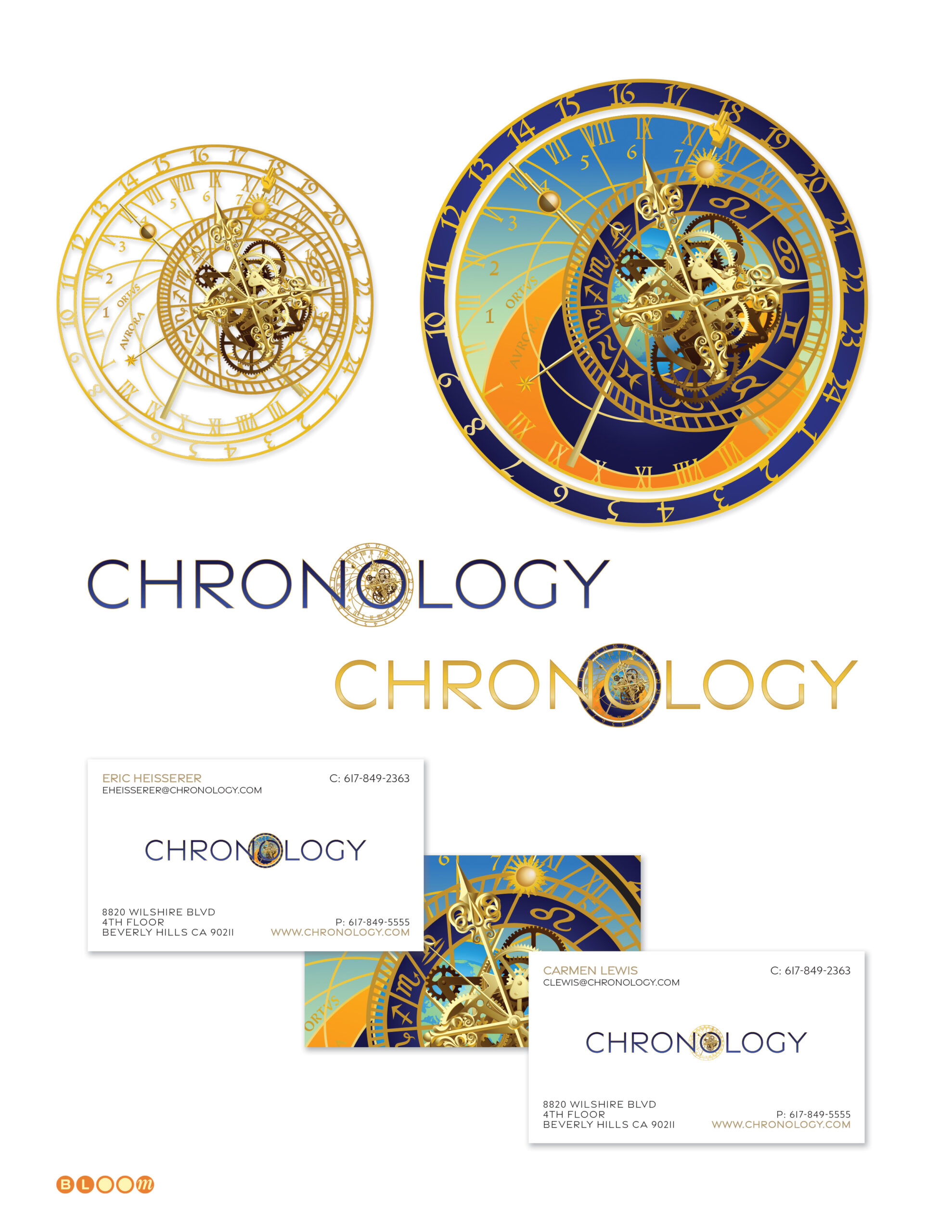
Chronology Productions identity system by Keith Bloom showing custom Orloj astronomical clock illustration in two colorways, CHRONOLOGY wordmark in navy and gold, and business card designs for Eric Heisserer's Hollywood production company

Some identity briefs arrive with the concept already latent in the name. Chronology Productions — a Hollywood production company founded by Academy Award-nominated screenwriter Eric Heisserer — needed a mark that could carry the weight of cinematic ambition, live gracefully in a credit reel, and communicate something about the relationship between storytelling and time. The answer was waiting in Prague.

The Orloj — the medieval astronomical clock installed in Prague’s Old Town Square in 1410 — is one of the most visually complex and historically resonant mechanical objects in existence. Its layered faces track solar and lunar time, the positions of celestial bodies, and the liturgical calendar simultaneously, all through an intricate system of gears, dials, and hands that has been turning for over six centuries. For a production company whose name is literally about time, no contemporary mark could compete with that lineage.

I illustrated the Orloj face from photographic reference — drawing the astronomical dial, the zodiac ring, the calendar face, and the surrounding architectural detail by hand to achieve the level of precision the concept required. The clockworks at the center are a composite of two stock illustration elements, layered and modified to create depth, visual richness, and — critically — animation readiness. Every layer was built to move. The clock was designed to turn.

The resulting mark embeds this fully realized Orloj illustration as the O at the center of the CHRONOLOGY wordmark — presented in two colorways: a refined gold line art version for single-color applications, and a full-color version in the deep navy, warm amber, and gold palette of the actual Prague clock for rich media and full-color contexts. The business card system carries the identity through to print with characteristic confidence — the clock face bleeding full across the card back as a detail image, the wordmark anchoring the front with clean spaced-cap authority.

The PowerPoint deck template completed the system. The engagement was carried out as an independent project alongside my role as a learning systems engineer at Cisco Systems — one of several creative commissions I maintained during that chapter to keep the practice fluid and the instincts sharp.

A footnote worth keeping: the identity work earned a valid IMDb membership for yours truly — a graphic designer’s entry into the same database that tracks every film the mark was built to precede.

Custom Illustration, Identity Design, Wordmark Design, Business Card System, Presentation Template Design

CubeSmart — National Brand Identity and Graphic Standards

CubeSmart didn’t begin as CubeSmart. It began as U•Store•It — an established national self-storage chain with hundreds of facilities across the country. The decision to rebrand, and the new name itself, came from the client. What they needed was someone to make that name into a mark — and the mark into a complete, living brand system that could govern every touchpoint of a national retail operation.

That’s where I came in. Commissioned as an independent project during my tenure at Cisco Systems, this was one of those engagements that demanded the full range of what I do best: custom type design, proportional precision, and the discipline to build a visual identity system rigorous enough to survive intact across thousands of facilities, dozens of advertising formats, and years of operational use.

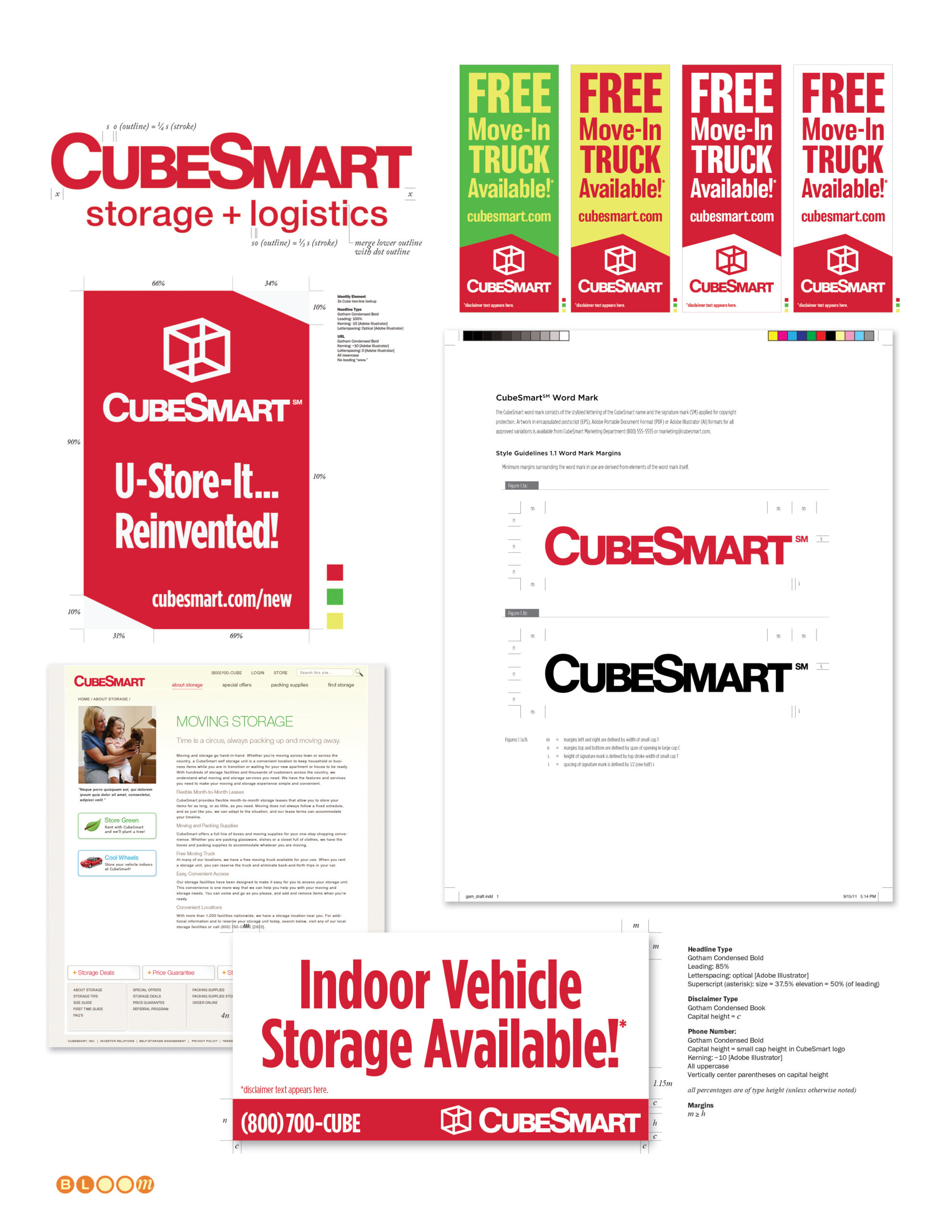
I designed the CubeSmart wordmark from scratch — custom-drawn letterforms with proprietary glyph modifications that give the mark its distinctive character and ensure it reads as a composed, unified whole. The cubic icon that accompanies the wordmark is deceptively simple: a three-dimensional form that communicates storage, structure, and spatial intelligence in a single gesture, drawn with the same precision and optical refinement as the letterforms it sits beside. The mark was built in both outlined and solid variants, with stroke weights specified to fractions of the cap height to ensure consistent reproduction across every application at every scale.

The engagement extended well beyond the mark into a comprehensive graphic standards manual — the document that transforms a logo into a living brand system. The manual specified everything: wordmark construction and minimum margin rules derived from the proportional relationships within the mark itself; a typographic system anchored by Gotham Condensed Bold for headline use, with precise leading, letterspacing, and kerning values specified for Adobe Illustrator production; disclaimer and legal type specifications; phone number formatting rules; color palette across print and digital applications; and layout proportion grids governing how brand elements relate to each other across every format.

That system was then applied across the full spectrum of CubeSmart’s physical and digital presence — outdoor and large-format advertising, banner and point-of-sale materials in multiple colorway variations, website UI design, and the launch campaign that announced the transformation to the world: “U-Store-It… Reinvented!” — a line that acknowledged the legacy directly while declaring the ambition of what was coming.

The standards also covered architectural signage, building facade treatments, interactive advertising templates, and employee uniforms — the full environmental and operational spectrum of a national retail brand. Every touchpoint, every format, every application governed by the same proportional logic and typographic discipline that begins in the wordmark itself.

CubeSmart remains in active national use today, visible on facilities across the country. That kind of longevity is the most honest measure of whether a brand identity was built to last.

Creative Direction; Logo Design; Typography Design; Graphic Standards; Indoor/Outdoor Signage; Operations Graphics

Yafo Networks — Identity, Website, and Print Design

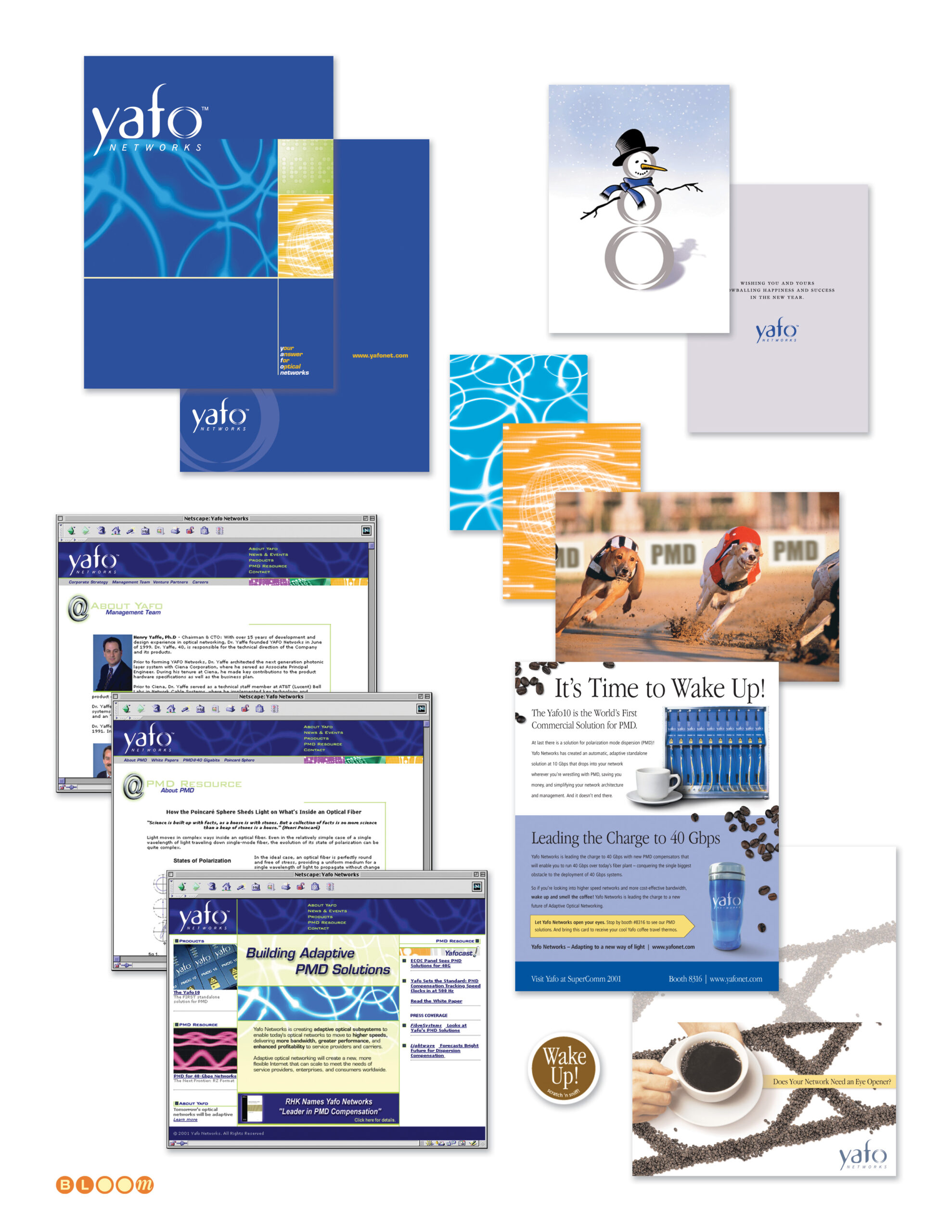
Yafo Networks creative folio showing brand identity, cobalt and aqua wordmark with orbital ring logo, Netscape frames-based website design, PMD print advertising, Wake Up trade show campaign, direct mail, and seasonal greeting card designed by The Bloom Agency

The name was, by the founders’ own admission, a joke — YAFO: Yet Another Fiber Optic networking solutions company. It was the kind of self-aware humor that signals a technically confident team comfortable enough with the crowded optical networking landscape of the early 2000s to acknowledge it directly, because they knew they had something nobody else had cracked.

What they had was a solution to polarization mode dispersion — PMD — the signal degradation phenomenon that was blocking telecommunications carriers from upgrading their existing fiber infrastructure to 40 Gbps speeds. The alternative to solving PMD was replacing the fiber. YAFO’s hardware and software compensation technology meant carriers could maximize the utility of their current assets instead. Founded in June 1999 by Henry Yaffe in Hanover, Maryland, the company raised $61 million in venture capital across three rounds before its acquisition by Ciena Corporation — a validation of both the technology and the market timing.

The Bloom Agency was engaged for the full creative scope of YAFO’s marketing communications: identity design, website design, print advertising, trade show campaign, direct mail, and corporate collateral — all of it built in the compressed, capital-intensive atmosphere of the early 2000s optical networking market.

The Yafo logo is my design — a lowercase wordmark in a deep cobalt and aqua palette, with an orbital ring element arcing over the o. The ring is a deliberate double reference: to the optical lenses at the heart of the technology, and to the high-speed networking rings the product was designed to liberate. Light moving through glass at extraordinary speed, made visible in a single typographic gesture.

The website was designed in frames-based architecture for Netscape — the production reality of early 2000s web development — with a full site structure covering corporate strategy, management team, product information, a PMD Resource educational center, press coverage, and investor relations. Getting technical depth and marketing clarity to coexist in that environment required both design discipline and genuine understanding of what the product actually did and why it mattered.

The trade show campaign for SuperComm 2001 — Booth 8316 — was anchored by the “It’s Time to Wake Up!” concept, built around the insight that the industry was sleeping on the PMD problem at 40 Gbps while YAFO had already solved it. The campaign extended across print advertising, trade show materials, and a direct mail invitation that arrived sealed with a coffee-flavored scratch and sniff sticker. The concept and the execution were in complete alignment: every recipient who scratched that seal understood the campaign before they read a word. The greyhound billboard composite — an early Photoshop background replacement technique used as a campaign visualization — rounded out the competitive speed messaging.

The seasonal greeting card completed the relationship collateral — a snowman assembled from the Yafo orbital ring elements, wishing clients and partners happiness and success in the New Year with the same quiet wit that named the company in the first place.

Brand Identity, Logo Design, Orbital Ring Illustration, Website Design, Frames Architecture, Print Advertising, Trade Show Campaign, Direct Mail, Scratch and Sniff Production, Corporate Collateral, Seasonal Greeting Card, Production Management

Screen47.com — “We’re Rolling”

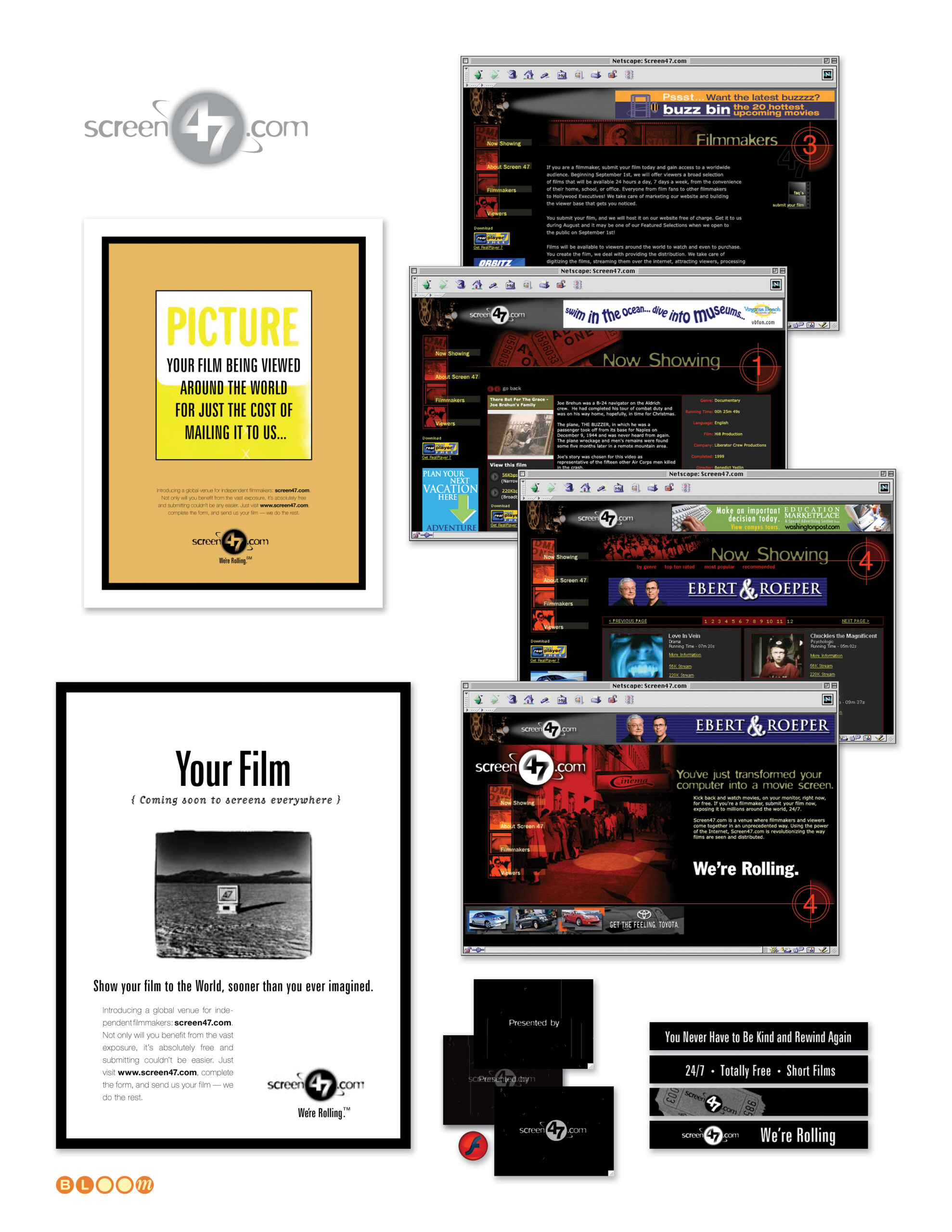
screen47.com campaign folio showing logo, Netscape 2.0 website UI designs, print advertising, direct mail, and Flash interactive elements created by The Bloom Agency — featuring the We're Rolling campaign line and Ebert and Roeper partnership

Before YouTube. Before broadband made streaming viable for the average household. Before anyone had coined the term user-generated content. There was screen47.com — a concept so ahead of its moment that the infrastructure to support it simply did not yet exist at the scale required.

The Bloom Agency was engaged to create the complete brand identity, website design, and marketing campaign for screen47.com — a global venue for independent filmmakers to submit, stream, and distribute their work to audiences worldwide, free of charge. The platform’s value proposition was elegant and genuinely radical for its time: you submit your film, we handle the distribution, the digitizing, the streaming, the audience building. Your film. Coming soon to screens everywhere.

The name encoded a quiet piece of conceptual depth — 47 is the atomic number of silver, a reference to the silver screen, tying a digital-native platform back to the physical poetry of cinema with a single numeral. The logo’s orbital ring system around that numeral suggested both planetary motion and content in perpetual circulation — a mark designed for a medium that hadn’t fully arrived yet.

The agency created the “We’re Rolling” campaign line — a phrase that does three things simultaneously: signals that the cameras are running, that the platform is live, and that the business has momentum. It ran across print advertising, direct mail, and the website UI itself, anchoring a visual system built in Netscape 2.0 that anticipated the streaming era with remarkable clarity.

The campaign attracted genuine institutional credibility. Film critics Roger Ebert and Richard Roeper were not merely conceptual supporters — they provided filmed endorsements specifically to support the client’s venture capital fundraising effort. That level of editorial endorsement for a platform concept that hadn’t yet reached scale speaks to how compelling the idea was to people who understood the future of film distribution.

A working demo of the site was built and demonstrated. The obstacle was not the concept, not the design, not the endorsements, and not the market appetite. It was bandwidth economics — access costs and service capacity made viable streaming prohibitively expensive at the scale required for the platform to gain real traction. The client ran out of runway before the infrastructure caught up. A competitor with a longer war chest and better timing eventually built the same idea and called it YouTube.

The work remains one of the most forward-looking engagements in The Bloom Agency’s history — and a reminder that being right about the future is not always enough.

Brand Identity, Logo Design, Campaign Concept, Tagline Development, Website Design, Print Advertising, Direct Mail, Interactive Design, Flash Production

CarrAmerica — Brand Standards, Property Marketing, Print Collateral

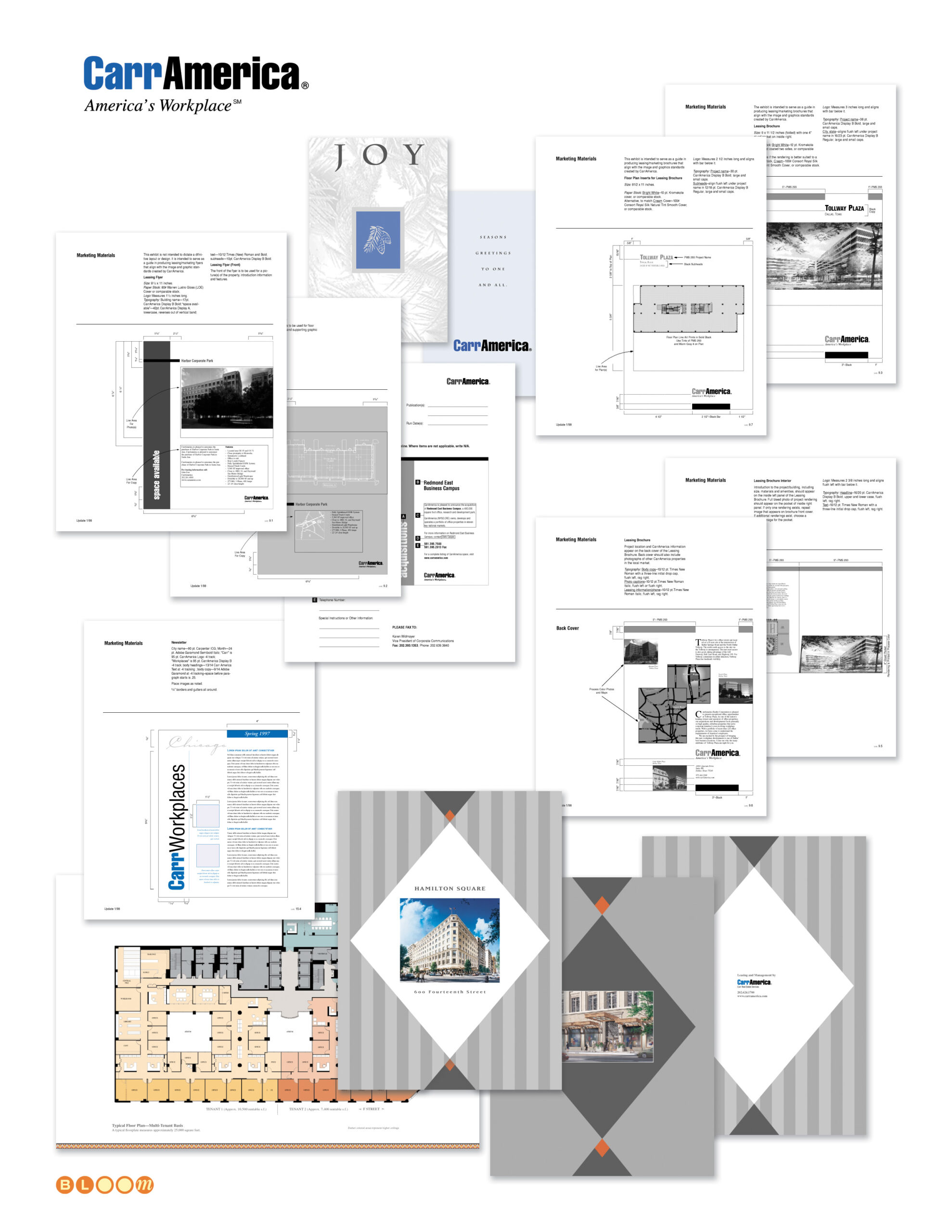
CarrAmerica brand standards and property marketing folio showing graphic standards manual pages, property leasing brochures for Tollway Plaza, Hamilton Square, Redmond East Business Campus and Fairfax Corporate Park, floor plan production, CarrWorkplaces newsletter, seasonal greeting card, and print advertising — designed and produced by The Bloom Agency

CarrAmerica was one of the largest publicly traded office real estate investment trusts in the United States in the mid-1990s, operating commercial properties across major markets including Washington DC, Dallas, and the Pacific Northwest under the tagline “America’s Workplace.” Managing a national property portfolio at that scale requires more than a recognizable logo — it requires a brand system rigorous enough to govern every leasing brochure, every property advertisement, every floor plan package, and every piece of tenant communication across dozens of properties in multiple markets, produced consistently by different teams in different cities.

The Bloom Agency was engaged to formalize, document, and extend CarrAmerica’s existing brand identity into a reproducible graphic standards system — taking a light existing framework and building it into a comprehensive set of rules governing typography, layout dimensions, color application, marketing materials production, and collateral specifications across every format the organization used. The standards manual became the definitive reference for CarrAmerica’s marketing communications: every measurement specified, every typeface documented, every layout grid defined, so that the brand could be reproduced consistently whether the property was in Dallas, Redmond, or downtown Washington DC.

That system was then applied across a sustained engagement producing the full spectrum of CarrAmerica’s marketing collateral. Individual property leasing packages — each one a self-contained marketing document for a specific building or campus — were designed and produced for properties including Tollway Plaza in Dallas, Redmond East Business Campus in the Pacific Northwest, Hamilton Square on 14th Street in Washington DC, and Fairfax Corporate Park in Northern Virginia. Each package carried its own visual character appropriate to its market and property type while remaining unmistakably within the CarrAmerica brand framework.

The floor plan production work was particularly exacting — architectural floor plans rendered and formatted for leasing materials, with multi-tenant layout variations showing different configuration options for prospective tenants. Getting floor plans to read clearly and persuasively as marketing documents, rather than merely as technical drawings, requires a specific kind of visual intelligence that sits at the intersection of information design and brand communication.

The engagement also produced the CarrWorkplaces newsletter system, a seasonal corporate greeting card program, print advertising for available space across the portfolio, and a standardized leasing inquiry response and fulfillment package system — the complete communications infrastructure of a national commercial real estate operation.

Brand Standards Formalization, Documentation and Extension, Graphic Standards Manual, Property Leasing Brochures, Floor Plan Production, Print Advertising, Newsletter Design, Corporate Communications, Collateral Design, Print Production Management