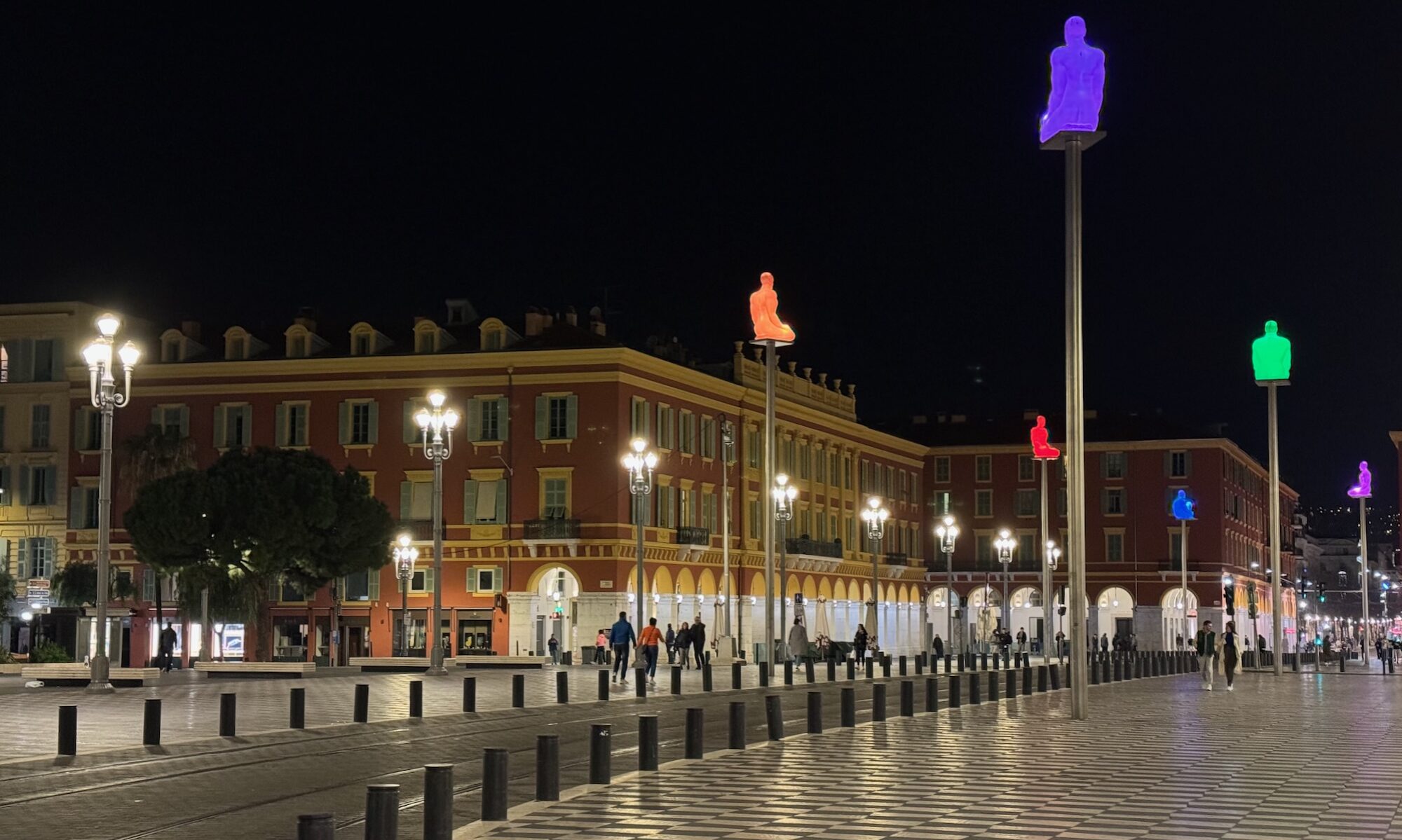
GATF/PIA — D4D: Variable Data Digital Printing Campaign

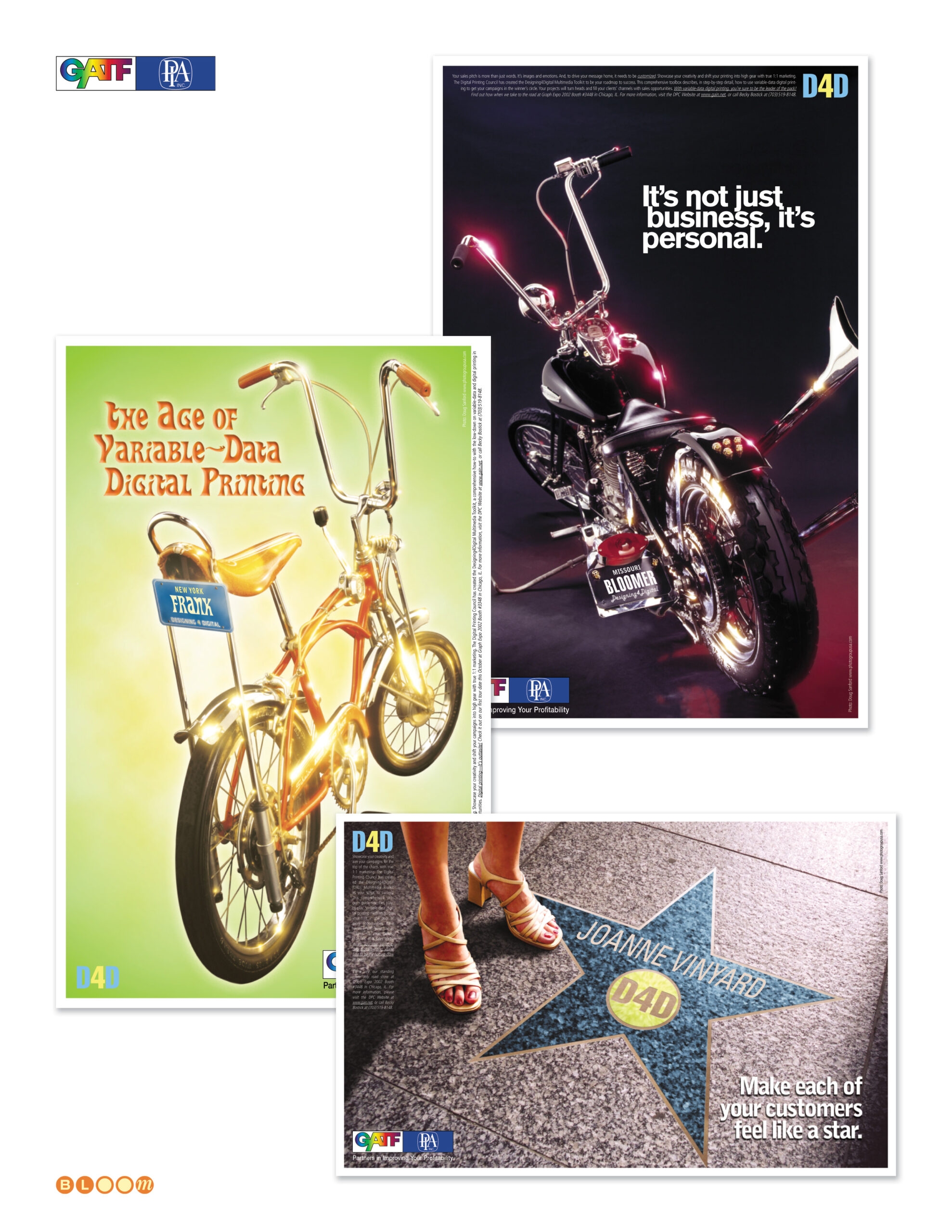
GATF PIA D4D Designing for Digital campaign folio showing three variable data poster concepts — Age of Variable Data Digital Printing bicycle poster, It's Not Just Business It's Personal motorcycle poster, and Make Each of Your Customers Feel Like a Star Hollywood Walk of Fame poster — creative direction and variable data template engineering by Keith Bloom at The Bloom Agency

In September 2001, HP announced its acquisition of Indigo N.V. for approximately $882 million — absorbing the Israeli company that had pioneered digital printing technology and bringing variable data digital printing into the mainstream of the global printing industry. Print Expo 2001 was held at precisely this inflection point, and the Graphic Arts Technical Foundation and Printing Industries of America chose it as the moment to demonstrate to the industry exactly what this technology could do in the hands of a skilled creative team.

The Bloom Agency was engaged to create that demonstration. As creative director, photography director, and account executive, I conceived and engineered the D4D — Designing for Digital — campaign from the ground up: a live variable data printing experience in which trade show attendees entered their name at a kiosk, selected one of three custom poster concepts, and received a full-color 11×17 personalized poster on heavy stock, rolled into a tube and ready to take home, printed in minutes on HP Indigo technology. It was one of the earliest large-scale public demonstrations of variable data digital printing as a consumer-facing creative experience.

The three poster concepts were each specifically composed and photographed to accept dynamically inserted personalized names with photo-realistic perspective and distortion — not as obvious overlays, but as elements that appeared physically present in the image. This required precise engineering of what I called type envelopes: carefully constructed zones within each photograph that controlled the perspective geometry and surface texture the variable text would need to match. Getting a name to read as if it were actually stamped on a bicycle license plate, engraved on a motorcycle plate, or embedded in a Hollywood Walk of Fame star required the photography to be built around the variable data mechanics from the first frame.

All three background images were conceived and produced specifically for this project. The bicycle and motorcycle were rented props, photographed in a studio in Silver Spring, Maryland. The Hollywood Walk of Fame star — “Make Each of Your Customers Feel Like a Star” — was shot in the lobby of the GATF building in Alexandria, Virginia, with the feet of one of my art directors standing at the edge of the star. Every inch of every image was designed to serve the production requirement.

The campaign was well received at Print Expo 2001 — but the show unfolded against an extraordinary backdrop. Print Expo 2001 was held in Chicago, and the attacks of September 11, 2001 occurred during the run of the show. The exhibition continued, attendees collected their personalized posters, and the demonstration of what variable data digital printing could do landed as intended — but the closing of US airspace in the days that followed left the client stranded in Chicago, unable to return home for several days. It is one of those production stories that sits permanently in the shadow of a larger event.

I was not present at the expo itself. The campaign was delivered into the capable hands of the client team for the show floor execution.

The campaign line was “The Age of Variable-Data Digital Printing” — and at Print Expo 2001, standing at the moment HP was absorbing Indigo and the industry was absorbing what that meant, it wasn’t a claim. It was a demonstration.

Creative Direction, Photography Direction, Account Executive, Variable Data Template Design and Engineering, Dynamic Type Envelope Architecture, Prop Photography
Lightscape Networks – XDM Launch Campaign

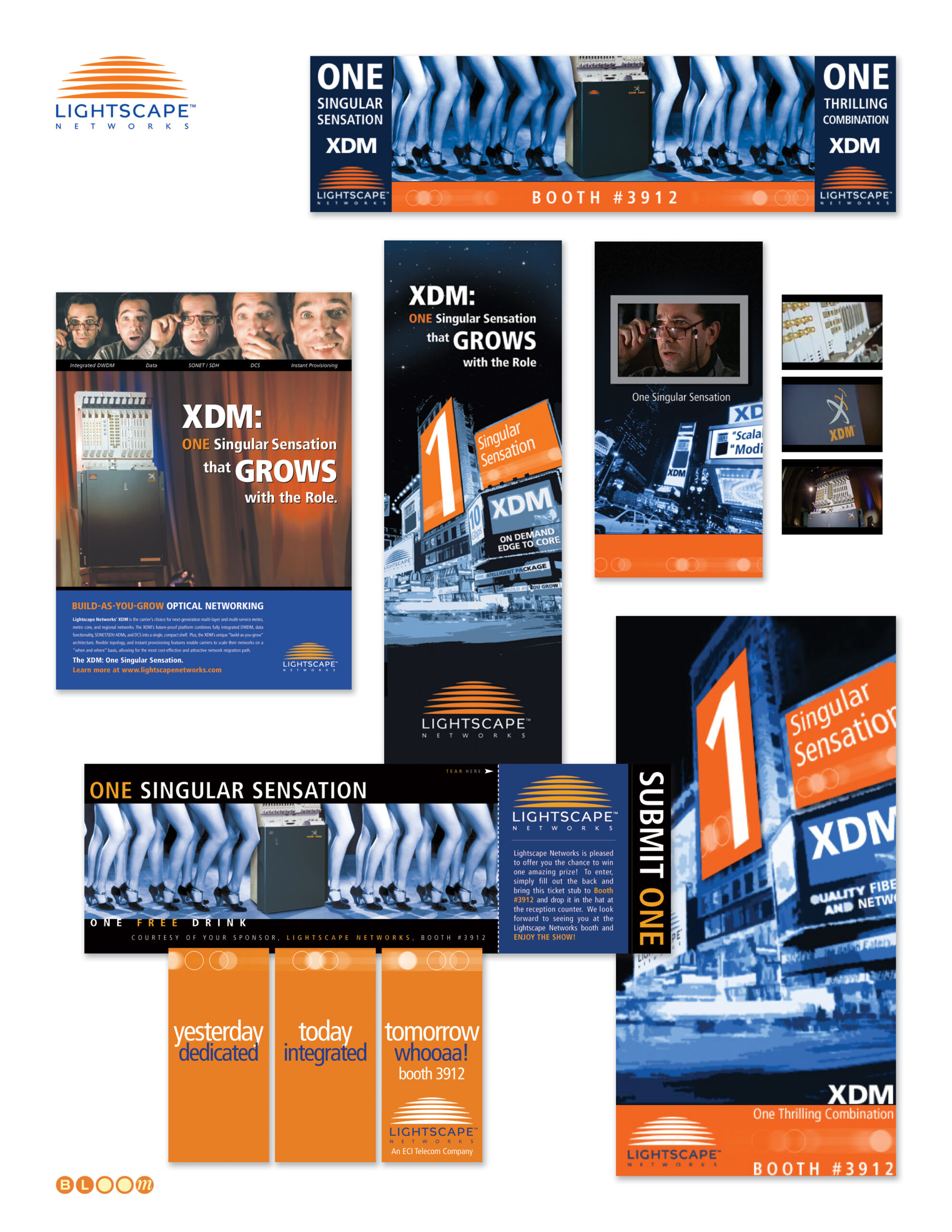
Lightscape Networks XDM launch campaign folio showing trade show booth graphics, print ads, direct mail, video stills, and collateral designed by The Bloom Agency — featuring the One Singular Sensation Broadway-themed campaign

In 2002, Morgan Stanley described Lightscape Networks as having “the finest converged product” in the metro optical transport market. What the Israeli-based ECI Telecom company lacked was a US market presence — and a trade show debut that would announce its arrival loudly enough to be heard over Cisco, Nortel, and a crowded field of surviving optical networking startups all competing for a finite pool of carrier capital spending.

The Bloom Agency was engaged to create the launch campaign for Lightscape’s XDM platform — a next-generation multi-service optical switch that combined SONET/SDH, DWDM, data switching, and digital cross-connect functionality into a single compact shelf — at the Optical Fiber Conference, one of the industry’s most significant annual gatherings. The strategic challenge was considerable: introduce a foreign manufacturer’s flagship product to a US audience already deeply invested in incumbent solutions, make it impossible to ignore at the show floor, and do it with the kind of creative confidence that signals a company ready to compete at the highest level.

The concept The Bloom Agency developed was “One Singular Sensation” — a deliberate Broadway reference that reframed Lightscape’s US debut as a theatrical opening night. The XDM’s core value proposition — one platform combining the functionality of multiple network layers — mapped perfectly onto the campaign line, which we carried across every touchpoint with consistent wit and visual energy. The concept was not just a headline. It was a fully produced campaign.

The video component was conceived and scripted entirely by The Bloom Agency. The production staged the XDM hardware as the sole performer on an auditorium stage — a wide-eyed director discovering its capabilities during a callback audition as the scene unfolds around it. Four booth attendant models dressed in authentic Broadway production costumes rented from a Los Angeles theatrical costume house completed the theatrical environment, presenting the hardware live against a booth backdrop featuring the production playing on continuous loop. The concept was fully committed: the XDM was the singular sensation, the trade show floor was opening night, and every engineer who stopped at booth 3912 was the audience.

The campaign extended across trade show booth graphics, print advertising, direct mail, conference collateral, and interactive display elements — all carrying the orange, navy, and black palette and the theatrical energy of the opening concept. The booth number — 3912 — became a recurring graphic element woven through the campaign, turning a logistical detail into a destination marker.

Lightscape’s XDM was, by most technical assessments, an exceptional product. The campaign we built for its US debut gave it an entrance worthy of that assessment. That the broader market battle ultimately went to entrenched incumbents is a story about timing and capital, not about the quality of the work — or the product.

Creative Direction, Campaign Concept, Art Direction, Trade Show Design, Print Advertising, Direct Mail, Video Production, Collateral Design