Architecting Intelligent Enterprises: Why AI Alone Won’t Create Durable Advantage

Flowing network of glowing interconnected nodes representing AI-enabled enterprise architecture and connected intelligent systems

Enterprise advantage is shifting. Not because of AI tools. Because of how organizations architect the systems around them.

Many enterprises are experimenting with AI right now. Pilots are running. Features are being deployed. Dashboards are being built. And most of it will not compound into durable competitive advantage — because isolated experimentation, however sophisticated, is not the same as intentional system design.

The companies pulling ahead are doing something different. They are designing connected enterprise ecosystems where data compounds across touchpoints rather than accumulating in silos, platforms integrate rather than coexist, decisions adapt in real time rather than lag behind the intelligence available to inform them, governance enables scale rather than throttling it, and strategy translates into execution rather than dissolving in the gap between them.

AI alone won’t create that. Architecture will.

My own career has spanned digital platforms, enterprise SaaS ecosystems, and global learning infrastructures serving distributed technical communities across four continents. That work now directly informs how I think about AI-enabled enterprise transformation — not as a theoretical framework, but as a pattern I have seen play out repeatedly across very different organizational contexts. The question is never whether AI is capable. It is whether the system around it is designed to let that capability compound.

Which is why I have been building something outside of client work as well. I am running a small Agentic AI lab environment using OpenClaw — currently the most widely adopted open-source agentic AI framework, with over 247,000 GitHub stars and enterprise deployment paths through NVIDIA and Red Hat. The lab is intentionally contained and security-conscious; OpenClaw’s power comes with real governance considerations that are themselves instructive. What I am exploring is how autonomous agents can augment both enterprise workflows and everyday productivity — not as a curiosity, but as applied research into the governance, orchestration, and system design questions that will define the next phase of enterprise strategy.

Those questions are coming for every organization. The ones with answers already in development will define the terms.

The next phase of enterprise strategy will belong to organizations that move beyond isolated pilots and begin intentionally designing systems that learn, adapt, and scale. Not just implementing AI. Architecting intelligent enterprises.

The Next Phase of Enterprise AI Isn’t About Tools. It’s About Operating Systems.

Flowing network of interconnected glowing nodes representing AI-enabled enterprise intelligence and connected operating system architecture

AI is reshaping enterprise advantage. But the organizations pulling ahead aren’t the ones with the most tools. They’re the ones that stopped thinking about AI as a tool category entirely.

That reframe matters more than it might sound.

Tools are discrete. You deploy them, measure them, and report on them in isolation. An operating system is different. It’s the architecture that makes everything else possible — not solving a single problem, but defining how the enterprise thinks, decides, learns, and adapts across all of its problems, continuously, at scale.

The next phase of transformation requires connected, intelligent ecosystems where data compounds rather than expires, decisions adapt rather than lag, architecture supports strategy rather than constraining it, governance enables scale rather than throttling it, and change is mobilized rather than mandated.

My Wharton Executive Education CSO Program capstone explored exactly this inflection point through the lens of a century-old entertainment conglomerate that had ceded distribution sovereignty to streaming platforms — becoming, as I framed it, a provider of siren calls to other parties’ platforms. The content was still world-class. The operating system connecting content to audiences, data to decisions, and engagement to compounding relationships simply didn’t exist. The strategic answer wasn’t more AI features. It was building the architecture those features needed to work within — connected profiles, connected transactions, connected content — turning isolated engagements into continuous relationships at scale.

The same diagnosis applies across sectors. Organizations that treat AI as isolated experimentation will struggle to scale advantage. Those that design for connection across systems, decisions, and people will pull ahead.

Technology leadership is evolving. From deploying AI features to architecting intelligent enterprises. From building tools to designing the operating systems those tools run on.

The tools are table stakes. The operating system is the advantage.

Transformation Doesn’t Collapse Loudly. It Fragments.

Two network diagrams side by side — left showing fragmented disconnected nodes, right showing a coherent reconnected system — illustrating enterprise transformation breakdown and recovery

Enterprise transformation rarely fails with a dramatic moment of collapse. There’s no single decision that breaks it, no meeting where it visibly dies. It fragments. Momentum slows imperceptibly. Priorities blur at the edges. Execution splits across silos that were supposed to be aligned. And one day the strategy that made complete sense in the deck feels distant from the work actually happening on the ground.

A strategy document doesn’t prevent that. Connection does.

This is the part of transformation leadership that gets the least architectural attention and causes the most organizational damage. Leaders invest heavily in the what — the roadmap, the model, the market logic — and underinvest in the connective tissue that keeps the what alive as the organization moves through it.

What that connective tissue actually requires: clarity about the inflection point — not just that change is necessary, but why it is necessary now, and what happens if it doesn’t happen. A defined direction of value creation that is specific enough to navigate by. Explicit links between individual roles and enterprise outcomes, so the people doing the daily work can see how their decisions shape performance at scale. And feedback loops designed to translate strategic intent into daily action — not annual reviews, not quarterly reports, but signals that arrive close enough to the moment to actually inform it.

At Cisco, building global programs across markets and functions, the recurring failure mode was not bad strategy. It was broken connection. Teams executing against objectives they understood in isolation but couldn’t map to the larger system. The strategy was sound. The narrative infrastructure wasn’t.

Which brings me to the line I keep coming back to: people don’t resist change. They resist disconnection.

Nobody wants to execute tasks without context. People want to understand how their decisions matter — how what they do today shapes what the enterprise becomes. That is not a soft skill or a communications afterthought. In AI-enabled transformation especially, narrative is connective infrastructure. It is what allows data to inform decisions, roles to produce outcomes, and feedback to drive adaptation.

When that connection holds, strategy scales. When it breaks, advantage disappears — not loudly, but steadily, until the fragments are too scattered to reassemble.

Build the connection before you need to rebuild the momentum.

From Transactions to Relationships: The Architecture of Continuous Enterprise

Layered interconnected platform architecture with glowing data nodes — representing connected enterprise design and AI-enabled continuous adaptation

Most organizations are still optimizing for transactions. The leaders are designing for continuous relationships.

That shift sounds subtle. It isn’t. It changes the fundamental architecture of how a business operates — what it measures, what it builds, how it makes decisions, and what it considers a win.

A transaction is a moment. A relationship is a system. And you cannot build a system that sustains relationships using infrastructure designed to process moments.

What continuous relationship design actually requires is harder to assemble than most organizations appreciate: integrated platforms that share state across every touchpoint rather than handing off between siloed applications. Data loops that compound over time — where each interaction makes the next one smarter, more relevant, more valuable to both sides. Operating models genuinely aligned to lifetime value rather than quarterly conversion. And governance structures flexible enough to enable personalization at scale without collapsing into chaos or compliance risk.

At Cisco, I worked inside exactly this challenge — architecting learning and partner ecosystems where the goal was not a single training completion or certification event, but sustained, compounding engagement across the lifetime of a partner relationship. The difference in design thinking required was significant. You stop asking “did they finish?” and start asking “are they growing?”

This is where AI becomes genuinely interesting — and genuinely misunderstood.

AI is not just automation. It is the intelligence layer that makes continuous enterprise adaptation possible. It is what allows a system to learn from every interaction, adjust in real time, and stay relevant across a relationship that evolves. But only if the underlying architecture is built to support it.

Which means the wrong question is: “Where can we apply AI?” That question leads to pilots. Proofs of concept. Isolated wins that don’t compound.

The better question is: “How do we architect systems where data, experience, and decision-making are always connected?” That question leads to infrastructure. To competitive advantage that accumulates rather than expires.

Competitive advantage won’t come from isolated AI pilots. It will come from connected enterprise design — where the intelligence layer has something coherent to work with.

Build the system first. Then let it learn.

The Real Work of Strategy Begins After the Deck Is Approved

A suspension bridge under construction with two unfinished spans nearly meeting in the middle — illustrating the gap between strategy and organizational mobilization

Most strategies don’t fail because the math is wrong. They fail because the organization never moves.

The quantitative side of strategy is rarely the hardest part. You can build a sound model, validate the market logic, stress-test the assumptions. I did exactly that during a significant transformation initiative at Cisco — architecting an enterprise roadmap around connected, personalized learning ecosystems at global scale. The models worked. The market logic held. The data told a coherent story.

What determined whether any of it actually happened was something harder to model: alignment.

Not agreement — alignment. There’s a difference. Agreement is what you get in the room. Alignment is what moves people when the room empties and the real work begins.

What traction required, specifically, was this: a clear “why now” that made the urgency felt rather than argued. A visible North Star that people could navigate toward without checking the deck every morning. Explicit links between legacy strengths and the future state — so the people who built what exists don’t feel erased by what’s coming. Cross-functional sequencing that respected how work actually flows rather than how org charts suggest it should. And executive sponsorship that was visible, sustained, and specific — not a signature on a slide.

If people don’t see themselves in the strategy, it doesn’t mobilize. Full stop.

Architecture matters. Analytics matter. But transformation happens when systems, incentives, and narrative align — when the story of where you’re going is as rigorous as the roadmap itself.

Most leaders underestimate that phase. They treat mobilization as a communications problem when it’s actually a design problem.

The real work of strategy begins after the deck is approved.

Logos and Identities

Collection of logo and identity designs by Keith Bloom including CubeSmart, Chronology Productions, Vélocity Bicycle Co-op, Georgetown Partnership, Hist1H1e Foundation, Cavalier Telephone, screen47, and The Third Way Foundation

Identity design is where my instincts are most exposed. There is nowhere to hide in a logo — every decision about form, weight, letter spacing, and concept is either right or it isn’t. The marks collected here span three decades, eight organizations, and a range of briefs as different from one another as their sectors. What connects them is a consistent design philosophy: type-driven, conceptually grounded, and built to work as hard as the organizations they represent.

CubeSmart is the flagship engagement in this collection and one of the most visible pieces of work in my portfolio. Commissioned for a complete rebrand of the national self-storage company, the assignment began with the wordmark — custom-drawn letterforms with proprietary glyph modifications that give the mark its distinctive character and ensure it reads as a composed, unified whole rather than a typeface applied. The cubic icon above the wordmark is deceptively simple — a three-dimensional form that communicates storage, structure, and spatial intelligence in a single gesture. The engagement extended well beyond the mark itself into a comprehensive graphic standards manual covering architectural signage, building facade treatments, interactive advertising templates, and employee uniforms — the full spectrum of environmental and brand identity practice delivered as a single coherent system. CubeSmart remains in active national use today.

Chronology Productions — founded by Academy Award-nominated screenwriter Eric Heisserer — called for a mark that could live in a credit reel as naturally as on a business card. The solution draws from the Orloj, the historic astronomical clock in Prague’s Old Town Square, adapting its intricate medieval clockwork geometry into the letter O at the center of the wordmark. Set in elegant spaced capitals with a warm gold palette, the mark feels simultaneously cinematic and timeless — and was conceived from the outset for animation, the clockwork mechanism designed to turn.

Hist1H1e Foundation is the most personal mark in this collection. Created pro bono for a lifelong friend and his wife, the identity supports a worldwide community of parents, physicians, and researchers united around a rare pediatric genetic disorder. The wordmark encodes the syndrome’s clinical name directly — Hist1H1e — with the double helix of a DNA strand completing the final letterform. It is a mark designed to make something invisible visible, and to give a scattered global community a recognizable emblem to gather around.

Vélocity Bicycle Co-op is a passion project and an ongoing one — I currently serve on the board of directors of this Washington, DC-area 501(c)(3) and am the organization’s visual identity steward. The refresh standardized and refined the custom workmark letterforms, and added structural detail and historical depth to the winged wheel mark — an homage to the Campagnolo winged quick-release wheel composition patented in the 1930s, one of the most iconic artifacts in cycling design history. The accent on the é is deliberate, a nod to the French cycling tradition from which so much of the sport’s visual language descends.

screen47.com was a concept ahead of its moment — a user-generated streaming video platform designed in a Netscape 2.0 environment, before YouTube existed or broadband made such a thing commercially viable. The name encodes a quiet piece of chemistry: 47 is the atomic number of silver, a reference to the silver screen. The mark uses an orbital ring system around the numeral, suggesting both planetary motion and the then-nascent concept of content in orbit around a digital hub.

Georgetown Partnership represents the business and civic interests of one of Washington’s most historically distinct neighborhoods. The mark draws its central image from the golden dome and cupola of the Farmers and Mechanics Bank at Wisconsin and M Streets NW — one of Georgetown’s most recognizable architectural landmarks — rendered in a warm gold that references the building’s gilded presence at that corner. The mark speaks directly to the audiences the Partnership engages: city and federal officials who understand immediately that this organization speaks for a neighborhood with real historical standing.

Cavalier Telephone entered the Mid-Atlantic telecommunications market as a competitive carrier in the post-AT&T deregulation landscape, serving neighborhoods underserved by the incumbent Bell companies. The identity needed to project infrastructure credibility and competitive energy simultaneously — the bold italic wordmark with its sweeping red speed stroke achieves both, suggesting momentum without sacrificing the solidity a telephone carrier requires. The engagement extended into award-winning broadcast animation and direct mail campaigns that earned ADDY Gold and Summit Creative Silver recognition.

The Third Way Foundation emerged from the centrist political tradition of the Democratic Leadership Council and Progressive Policy Institute — the intellectual infrastructure of the Clinton presidency era. The identity brief called for something that could operate credibly in Washington’s political environment without the visual language of either party: the clean, spaced serif wordmark with its understated rule achieves exactly that equilibrium, projecting authority without ideology.

Creative Direction, Art Direction, Identity Design, Custom Type, Glyph Modification, Graphic Standards, Environmental Signage, Illustration


21st Century Consort — Website, Performance Archive, and Streaming Library

21st Century Consort website folio showing homepage, searchable performance archive spanning 44 seasons and 774 performances, concert listings, recordings catalog, and custom streaming audio player designed and developed by Keith Bloom in ExpressionEngine

The 21st Century Consort was founded in 1975 as the 20th Century Consort — the resident ensemble for contemporary music at the Smithsonian Institution. For over four decades, the group has performed world premieres and balanced concert programming at St. Mark’s Episcopal Church on Capitol Hill, the Hirshhorn Museum and Sculpture Garden, and the Smithsonian American Art Museum, under the artistic direction of Christopher Kendall. By any measure it is one of Washington’s most significant serious music institutions — and one whose digital presence needed to match the depth and rigor of its archive.

This was a full technical and creative engagement, carried out as an independent project alongside my tenure at Cisco Systems. I designed and built the site in ExpressionEngine — beginning with version 2.5 and maintaining it through versions 5 and 6 over the course of the relationship — developing the content architecture, layout system, and CMS structure that would accommodate both the organization’s ongoing season programming and its deepening historical archive.

The performance archive is the heart of the site and its most technically ambitious component: a fully searchable database spanning 44 seasons, 183 concerts, 630 compositions by 253 composers, documented across 774 individual performances — all retrievable by title, name, or date, with individual program notes, composer profiles, and concert records fully cross-referenced. Building and maintaining that architecture — and populating it as decades of analog recordings were digitized from archive tapes and other legacy media and added in batches — was as much a library science project as a web development engagement. The physical recordings themselves — 557 DVDs and CDs archived by recording engineer Curt Wittig — are permanently preserved at the Michelle Smith Performing Arts Library at the University of Maryland, with the digital archive serving as the public access layer for that collection. The National Endowment for the Arts supported the archive’s development through performance grants beginning in 1984, with a specific grant in 2009 to fund the website itself.

The streaming audio player was co-developed with Pete Campbell, who contributed the initial jQuery and JavaScript assets before I assumed full ownership of scripting updates and revisions. The player went through multiple iterations tracking the evolution of streaming infrastructure — from Darwin Streaming Server through at least two successive IceCast Streaming Media service versions — each requiring the media library and player architecture to be adapted accordingly.

The client behind this project was, in his own way, a perfect collaborator — a deeply technical database enthusiast who shared the same appetite for chasing elegant solutions that’s always driven my best work. Many of the annual media library import sessions happened in cafes and shared workspaces around Washington, two people who genuinely enjoyed the problem as much as the solution. That kind of working relationship is rare, and it produced something that held together through nearly two decades of technological change.

In 2021, the client transitioned leadership of the digital relationship to a new board member who standardized the main site around a WordPress platform. The streaming library architecture wasn’t compatible with the new infrastructure, and the long collaboration concluded. What remains is a record of what was built — and something more than a record. The performance archive, still running on the IceCast streaming infrastructure as originally designed and built, continues to serve the complete catalog of 44 seasons, 630 compositions, and 774 performances to listeners worldwide, long after the main site moved to a new platform. The architecture quietly outlasted the transition.

Website Design, CMS Development, ExpressionEngine, Performance Archive Database Architecture, Streaming Audio Player Design and Development, IceCast Streaming Media Integration, Media Library Architecture, Content Management, Annual Media Library Updates

www.21stcenturyconsort.org

Chronology Productions — Identity System

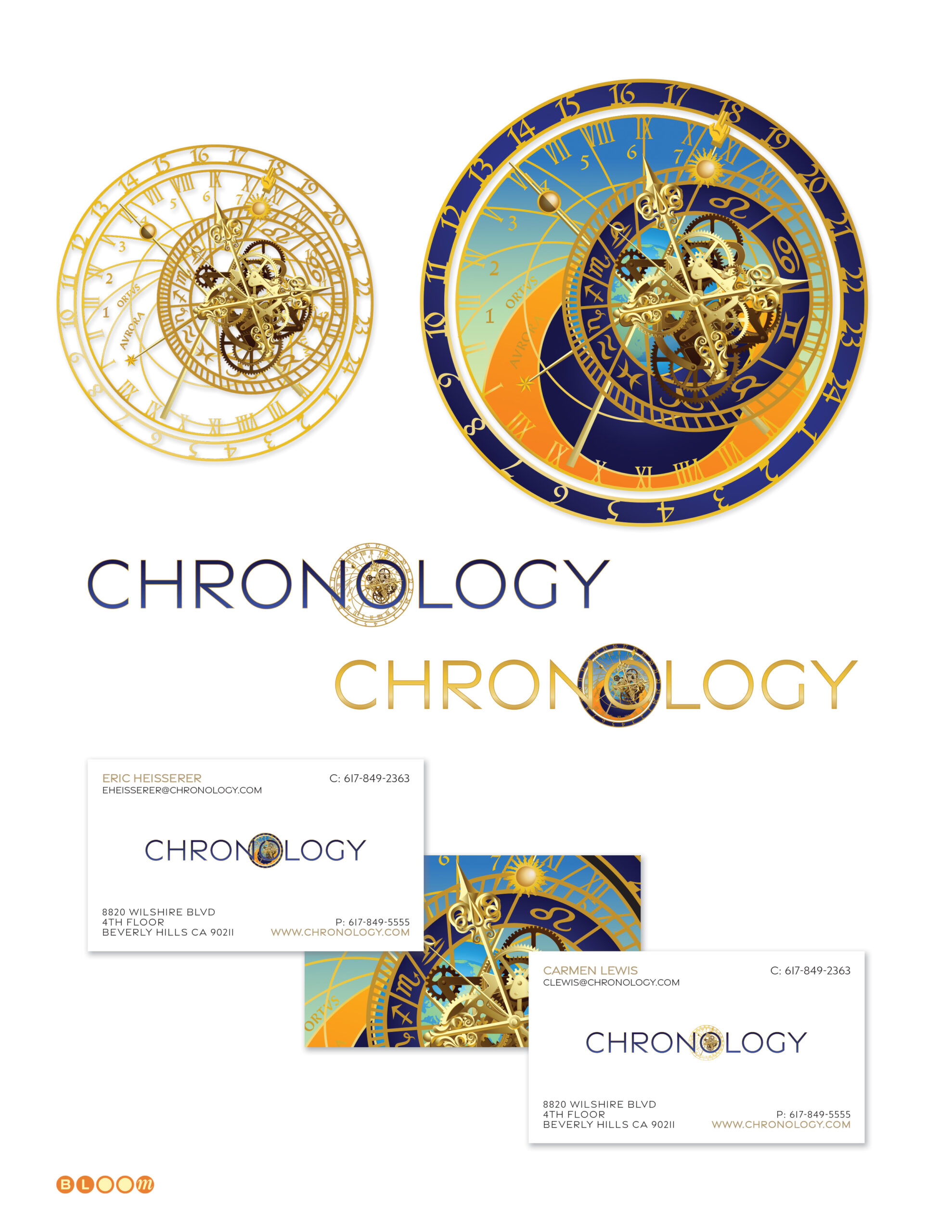
Chronology Productions identity system by Keith Bloom showing custom Orloj astronomical clock illustration in two colorways, CHRONOLOGY wordmark in navy and gold, and business card designs for Eric Heisserer's Hollywood production company

Some identity briefs arrive with the concept already latent in the name. Chronology Productions — a Hollywood production company founded by Academy Award-nominated screenwriter Eric Heisserer — needed a mark that could carry the weight of cinematic ambition, live gracefully in a credit reel, and communicate something about the relationship between storytelling and time. The answer was waiting in Prague.

The Orloj — the medieval astronomical clock installed in Prague’s Old Town Square in 1410 — is one of the most visually complex and historically resonant mechanical objects in existence. Its layered faces track solar and lunar time, the positions of celestial bodies, and the liturgical calendar simultaneously, all through an intricate system of gears, dials, and hands that has been turning for over six centuries. For a production company whose name is literally about time, no contemporary mark could compete with that lineage.

I illustrated the Orloj face from photographic reference — drawing the astronomical dial, the zodiac ring, the calendar face, and the surrounding architectural detail by hand to achieve the level of precision the concept required. The clockworks at the center are a composite of two stock illustration elements, layered and modified to create depth, visual richness, and — critically — animation readiness. Every layer was built to move. The clock was designed to turn.

The resulting mark embeds this fully realized Orloj illustration as the O at the center of the CHRONOLOGY wordmark — presented in two colorways: a refined gold line art version for single-color applications, and a full-color version in the deep navy, warm amber, and gold palette of the actual Prague clock for rich media and full-color contexts. The business card system carries the identity through to print with characteristic confidence — the clock face bleeding full across the card back as a detail image, the wordmark anchoring the front with clean spaced-cap authority.

The PowerPoint deck template completed the system. The engagement was carried out as an independent project alongside my role as a learning systems engineer at Cisco Systems — one of several creative commissions I maintained during that chapter to keep the practice fluid and the instincts sharp.

A footnote worth keeping: the identity work earned a valid IMDb membership for yours truly — a graphic designer’s entry into the same database that tracks every film the mark was built to precede.

Custom Illustration, Identity Design, Wordmark Design, Business Card System, Presentation Template Design

CubeSmart — National Brand Identity and Graphic Standards

CubeSmart didn’t begin as CubeSmart. It began as U•Store•It — an established national self-storage chain with hundreds of facilities across the country. The decision to rebrand, and the new name itself, came from the client. What they needed was someone to make that name into a mark — and the mark into a complete, living brand system that could govern every touchpoint of a national retail operation.

That’s where I came in. Commissioned as an independent project during my tenure at Cisco Systems, this was one of those engagements that demanded the full range of what I do best: custom type design, proportional precision, and the discipline to build a visual identity system rigorous enough to survive intact across thousands of facilities, dozens of advertising formats, and years of operational use.

I designed the CubeSmart wordmark from scratch — custom-drawn letterforms with proprietary glyph modifications that give the mark its distinctive character and ensure it reads as a composed, unified whole. The cubic icon that accompanies the wordmark is deceptively simple: a three-dimensional form that communicates storage, structure, and spatial intelligence in a single gesture, drawn with the same precision and optical refinement as the letterforms it sits beside. The mark was built in both outlined and solid variants, with stroke weights specified to fractions of the cap height to ensure consistent reproduction across every application at every scale.

The engagement extended well beyond the mark into a comprehensive graphic standards manual — the document that transforms a logo into a living brand system. The manual specified everything: wordmark construction and minimum margin rules derived from the proportional relationships within the mark itself; a typographic system anchored by Gotham Condensed Bold for headline use, with precise leading, letterspacing, and kerning values specified for Adobe Illustrator production; disclaimer and legal type specifications; phone number formatting rules; color palette across print and digital applications; and layout proportion grids governing how brand elements relate to each other across every format.

That system was then applied across the full spectrum of CubeSmart’s physical and digital presence — outdoor and large-format advertising, banner and point-of-sale materials in multiple colorway variations, website UI design, and the launch campaign that announced the transformation to the world: “U-Store-It… Reinvented!” — a line that acknowledged the legacy directly while declaring the ambition of what was coming.

The standards also covered architectural signage, building facade treatments, interactive advertising templates, and employee uniforms — the full environmental and operational spectrum of a national retail brand. Every touchpoint, every format, every application governed by the same proportional logic and typographic discipline that begins in the wordmark itself.

CubeSmart remains in active national use today, visible on facilities across the country. That kind of longevity is the most honest measure of whether a brand identity was built to last.

Creative Direction; Logo Design; Typography Design; Graphic Standards; Indoor/Outdoor Signage; Operations Graphics

Catering by Windows — Advertising and Print Collateral Design

Catering by Windows French menu system folio showing high-key food photography, elegant white space grid layout, and warm typography designed by Keith Bloom for their flagship catering menu

Catering by Windows was one of Washington DC’s premier full-service catering and event companies — capable of producing an elaborate tented dinner for 300 or an intimate luncheon for 20, with equal attention to elegance, detail, and the particular personality of each occasion. The brief called for printed materials that communicated that range without sacrificing the visual sophistication their clientele expected.

The Bloom Agency handled advertising, catering menu design, and event catalog production for Catering by Windows’ flagship printed collateral — a sustained engagement across multiple major projects in the early 2000s. The work spans two distinct visual registers that speak to the breadth of the client’s offering: a refined, high-key French menu system built around clean white space, warm typography, and intimate food photography; and a rich, jewel-toned wedding and special events collection anchored by dramatic tablescapes, tiered wedding cakes, and the quietly confident campaign line “We do…” — two words that do everything simultaneously.

Photography direction for both systems was my responsibility, conducted on location in Catering by Windows’ facility showrooms and commercial kitchens. Getting food and event photography right at this level requires more than a skilled photographer — it requires someone who understands both the visual language of luxury hospitality and the specific story each image needs to carry within the larger collateral system. The fig imagery that anchors the French menu system, the candlelit tablescapes in the wedding brochure, the precise arrangement of prepared dishes in the catering catalog — all of it was directed and produced to serve the design rather than the other way around.

The engagement also included a co-branded collateral piece for Catering by Giant — a partnership between Catering by Windows and Giant Food that required a dedicated sub-brand identity and marketing materials carrying both partners’ visual presence with coherence and appropriate hierarchy.

Across both folios the Windows logotype — a custom wordmark in which the double-O carries a distinctive window pane graphic — anchored a consistent brand presence through every format, from full-size event catalogs and multi-panel brochures to direct mail and advertising pieces.

Creative Direction; Photography Direction; Copy Writing; Production Management; Account Executive